Food tasting: Temple Bar
Viator
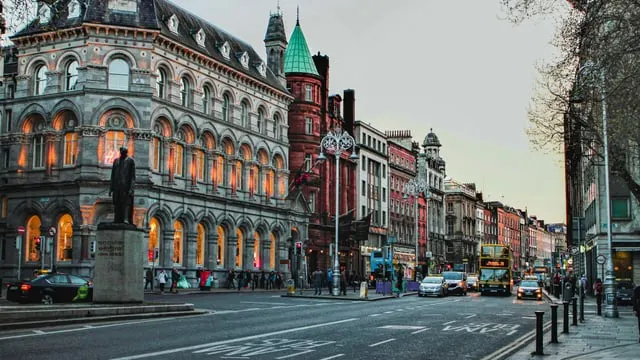
Dublin is a compact capital on the River Liffey, where medieval cathedrals and a Viking past sit beside broad Georgian squares and a modern waterfront. Free national museums and galleries, green squares and a rich literary history make it easy to fill a few days on foot, with the sea and the Wicklow hills a short ride away.
Maps and trail data © OpenStreetMap contributors (ODbL).
Three days in Dublin make a rounded first visit, from Kilmainham Gaol and Trinity College to the cathedrals of the old city and the Georgian squares of the south side. The route also takes in the Docklands, the Jeanie Johnston Tall Ship and the National Gallery of Ireland. It suits first-timers who want the famous sights at a comfortable walking pace.
Long weekend · 3 days · 2 adults ·
 1
 2
 3
 4
 5
 6
About 10 min by taxi
10:50 Kilmainham Gaol · Morning · 90–105 min8–10 min walk
12:28 IMMA and the Royal Hospital Kilmainham · Midday · 60–90 minBus 68 · about 30–33 min
14:01 St Stephen's Green · Afternoon · 45–90 min7–9 min walk
14:53 National Museum of Ireland – Archaeology · Afternoon · 1–2 h8–10 min walk
16:01 Trinity College and the Book of Kells · Afternoon · 90–120 min10–13 min walk
09:40 St Patrick's Cathedral · Morning · 45–75 min5–7 min walk
10:30 Dublinia · Morning · 75–90 min8–10 min walk
11:53 Marsh's Library · Morning · 30–45 min8–10 min walk
12:31 Christ Church Cathedral · Midday · 45–60 min9–12 min walk
13:25 Temple Bar · Midday · 30–60 min1 min walk
13:56 Ha'penny Bridge · Midday · 10–20 min1 min walk
14:07 The Liffey quays and boardwalk · Afternoon · 20–40 minLuas Red · about 12–13 min
14:40 National Museum of Ireland – Decorative Arts & History (Collins Barracks) · Afternoon · 90–150 min3–4 min walk
10:18 Famine Memorial · Morning · 10–20 min3–4 min walk
10:31 The Docklands quays · Morning · 45–90 min3–4 min walk
11:19 Jeanie Johnston Tall Ship · Morning · 50–60 min10–13 min walk
12:19 Sweny's · Midday · 15–30 min4–5 min walk
12:38 Merrion Square · Midday · 30–60 min13–17 min walk
13:21 Museum of Literature Ireland (MoLI) · Midday · 1–2 h9–12 min walk
14:30 Grafton Street · Afternoon · 30–60 min3–4 min walk
15:03 Molly Malone Statue · Afternoon · 5–15 min8–10 min walk
15:16 Little Museum of Dublin · Afternoon · 45–60 min9–12 min walk
16:10 National Gallery of Ireland · Afternoon · 90–150 minFlights, car rental and airport transfers for your trip: 3 days · 1 adult.
We may earn a commission when you book through partner links, at no extra cost to you.
How Troovz stays freeFly from anywhere, to anywhere.
Pick an area, then a place that fits your budget and style.
We may earn a commission when you book through partner links, at no extra cost to you.
How Troovz stays freeUses cookies
Tours and tickets matched to your plan and interests. Tap the heart to save one for Build your own.
We may earn a commission when you book through partner links, at no extra cost to you.
How Troovz stays freeViator
Viator
Viator
Viator
Viator
Viator
Viator
Viator
Tours, day trips and more on Viator
Browse all toursOpen to visitors, with a few customs.
Churches
Churches are usually open to visitors outside services, and some areas may close while a service is on. Visitors are usually asked to dress modestly, with shoulders and knees covered, and to keep their voices down. Photography rules usually vary, and flash is often not allowed. Rules can vary, so please follow any instructions and ask the staff on arrival.
What to sort before your 3-day trip, plus a few useful words.
We may earn a commission when you book through partner links, at no extra cost to you.
How Troovz stays freePlug type G
230 V, 50 Hz
Mobile data for your trip. Set it up before you fly.
per plan, one phone
See plans(opens in a new tab)Leave your bags for a few hours or a day.
per bag a day
Find storage(opens in a new tab)Places to eat near your plan and your stay. Tap the heart to save one.
Chosen from places featured in respected travel and food guides, or on a halal certifier's list, as of November 2026. We don't take payment to include a place.
Please confirm with the restaurant if you have any allergies.
 11 min from George's Street Arcade
Katsu curry: panko chicken breast with Japanese curry sauce and steamed rice · Grafton Street & St Stephen's Green
Price level$$$
Vegan optionsVegetarian options
Sources
Vegan options: Source: the restaurant's own menu
Vegetarian options: Source: the restaurant's own menu
Price level: Source: Yamamori, checked Nov 2026
 21 min from Temple Bar
Gaelic boxty: a potato pancake with beef fillet medallions, pepper sauce and mushrooms · Temple Bar
Price level$$$
Vegetarian options
Sources
Vegetarian options: Source: the restaurant's own menu
Price level: Source: Gallagher's Boxty House, checked Nov 2026
 31 min from Molly Malone Statue
Cauliflower tacos with cashew cream, rainbow slaw and mango and jalapeño marmalade · Grafton Street & St Stephen's Green
Price level$$
Sources
Price level: Source: Avoca, checked Nov 2026
 42 min from Christ Church Cathedral
Fresh cod in batter with chunky chips · Temple Bar
Price level$
Sources
Price level: Source: The Irish Times, checked Nov 2026
 52 min from Molly Malone Statue
The traditional crêpe with lemon, sugar and butter · Grafton Street & St Stephen's Green
Price level$
Gluten-free optionsVegetarian options
Sources
Gluten-free options: Source: the restaurant's own menu
Vegetarian options: Source: the restaurant's own menu
Price level: Source: Lemon Crepe & Coffee Co., checked Nov 2026
 62 min from Grafton Street
Turkish eggs: poached eggs on garlic yoghurt with hazelnut dukkah and sourdough toast · Grafton Street & St Stephen's Green
Price level$$
Gluten-free optionsVegetarian options
Sources
Gluten-free options: Source: the restaurant's own menu
Vegetarian options: Source: the restaurant's own menu
Price level: Source: The Pepper Pot, checked Nov 2026
No places near your plan with this option
 33
Lamb nihari · The Liberties & Kilmainham
Price level$$
Halal optionsVegan optionsVegetarian options
Sources
Halal options: Halal options available. Source: the restaurant's own menu. Please confirm locally.
Vegan options: Source: the restaurant's own menu
Vegetarian options: Source: the restaurant's own menu
Price level: Source: Al Khair Restaurant, checked Nov 2026
 34
Chargrilled spiced chicken sandwich with slow-roast tomatoes and lemon and basil mayo · Ballsbridge
Price level$$
Vegetarian options
Sources
Vegetarian options: Source: the restaurant's own menu
Price level: Source: Juniors Deli & Cafe, checked Nov 2026
 35
Margherita DOC pizza with buffalo mozzarella and basil · Ballsbridge
Price level$$
Gluten-free optionsVegan optionsVegetarian options
Sources
Gluten-free options: Source: the restaurant's own menu
Vegan options: Source: the restaurant's own menu
Vegetarian options: Source: the restaurant's own menu
Price level: Source: Paulie's Pizza, checked Nov 2026
Green escapes and the sea, a short trip from the centre. Planning information only.

Free entry
One card for most rides on public transport. Airport routes are in Flights.
The TFI Leap Card is a reusable travel card that you load with credit and tap on Dublin Bus, Go-Ahead Ireland city buses, the Luas and DART and commuter trains. It costs less than paying cash, includes any changes made within 90 minutes in the first fare, and stops charging once the daily or weekly cap is reached. One card per person: a fare paid for a companion is not capped.
Per person, paid locally · as of November 2026
Your 3-day plan usesTram and metroBusesTaxi
Licensed taxis charge by the meter at a set national rate: a start fee covers the first 500 metres, then a charge per kilometre, or per minute in slow traffic, with a higher rate in the evening, overnight, on Sundays and on public holidays. Booking by phone or app adds a small fee, each extra adult adds a little more, and you can pay by cash or card with no card surcharge.
Typical costs, and how to pay.
Excluding your stay.
| Per person, per day | Budget | Mid-range | Comfort |
|---|---|---|---|
| Breakfast | EUR 9 | EUR 14 | EUR 18 |
| Lunch | EUR 16 | EUR 19 | EUR 30 |
| Dinner | EUR 19 | EUR 30 | EUR 35 |
| Drinks | EUR 6 | EUR 14 | EUR 19 |
| Getting around | EUR 8 | EUR 8 | EUR 18 |
| Sights (entry tickets) | EUR 45 | EUR 45 | EUR 45 |
| Total a day | EUR 103 | EUR 130 | EUR 165 |
Sights are counted at the standard entry ticket. Guided tours cost more.
Typical prices, as of November 2026
Cards are widely used in Dublin: Visa and Mastercard are accepted almost everywhere, while American Express is taken in some places but not all. Contactless payment is common, and card payments use chip and PIN, so know your PIN before you travel.
ATMs run by banks are usually cheaper than stand-alone machines, though many banks also charge foreign cards a fee. If asked, choose to be charged in Euro. Your own bank may also charge a foreign-use fee. Check with your bank before you go.
Tipping is optional. In a sit-down restaurant about 10 percent is usual for good service, but check the bill first: some restaurants add a discretionary service charge of 12.5 percent, usually for larger groups, and then no extra tip is needed.
Grafton Street & St Stephen's Green
Seasons, weather, and the events and holidays that change opening hours, crowds and prices.
Quick answers to common questions.
Three days covers the main sights of the city centre at an easy pace, with time for a museum or two each day. Trinity College and the Book of Kells usually take about 90 to 120 minutes, and a guided tour of Kilmainham Gaol about 90 to 105 minutes. A fourth or fifth day leaves room for Phoenix Park, Glasnevin or a day trip to Howth or Glendalough.
Dublin has a mild, changeable climate, so a light waterproof is useful in any month. The summer months and the days around St Patrick's Day in March are usually the busiest, with higher room prices. Spring and early autumn are usually quieter, and the weeks before Christmas bring markets and lights but also busy streets.
There is no airport train. The Dublin Express coach leaves from outside both terminals and reaches the quays by O'Connell Bridge in about 33 minutes, with online fares from EUR 9. Bus 16 and Bus 41 of Dublin Bus are slower but cost EUR 2 with a Leap card, and a taxi to the centre usually costs about EUR 30 to EUR 45. As of 23 Nov 2026.
Dublin has buses run by Dublin Bus and Go-Ahead Ireland, two Luas tram lines and the DART coastal train. With a Leap card, one adult fare of EUR 2 covers changes between bus, Luas and DART within about ninety minutes. Buses take exact coins only and give no change, and Luas tickets are sold at the platform machines, not on board. As of 23 Nov 2026.
The city centre is compact and most sights between Kilmainham and the Docklands are within a walk or a short ride. For longer hops, the Luas trams and the buses cover the city, and the lowest adult Leap fare is EUR 1.50. Taxis use a meter, and the Uber, FREENOW and Bolt apps book licensed taxis. As of 23 Nov 2026.
A Leap card saves money compared with cash fares and stops charging at a daily cap of EUR 6 and a weekly cap of EUR 24. For a short visit, the Leap Visitor Card gives unlimited travel on bus, Luas and DART for one day at EUR 8, three days at EUR 18 or seven days at EUR 24, and it also covers Dublin Bus routes to the airport. It is sold at the airport and online. As of 23 Nov 2026.
Taxis use a meter set to the national maximum fare. A ride of about five kilometres on a weekday daytime usually costs about EUR 10.34, and more at night, on Sundays and on public holidays. From the airport to the city centre a taxi usually costs about EUR 30 to EUR 45. As of 23 Nov 2026.
Tipping is not compulsory. In a sit-down restaurant about 10 percent is usual for good table service, but check the bill first, because some places add a service charge of 12.5 percent, especially for groups, and then no extra tip is needed. In cafés and for counter service, tipping is up to you.
Cards are widely used, and contactless payment by card or phone is very common; Visa and Mastercard are the most widely accepted, while American Express is taken in some places but not all. A few coins are useful on Dublin Bus, which takes exact cash only if you have no Leap card. Cash machines are easy to find, and if a machine or a shop offers to charge you in your home currency, paying in euro is usually cheaper.
Hotel, guesthouse and other paid accommodation prices in Ireland include VAT at the reduced rate of 13.5 percent, which is already part of the price you are quoted. As of 23 Nov 2026.
Kilmainham Gaol is the main one: visits are by guided tour only and tickets must be booked online in advance, and they often sell out. The Book of Kells Experience at Trinity College uses timed tickets, so booking ahead is the usual choice, and the Little Museum of Dublin is also visited by guided tour with limited places. Rooms are worth booking early around St Patrick's Day and in summer.
Ireland uses the three-pin type G plug, with a mains supply of 230 volts. If your devices use another plug shape, bring an adapter, and check that your charger accepts this voltage before you plug it in.
English is the everyday language of Dublin, and Irish is the first official language, so signs are usually in both. In the most recent census, 83 percent of people who speak another language at home said they speak English well or very well. You will not need any Irish to get around. As of 23 Nov 2026.
Dublin is one of the pricier cities in Europe for rooms and meals, but many of its main sights are free, including the National Gallery, the National Museum of Archaeology, St Stephen's Green and Phoenix Park. A budget day of a pastry, coffee, a casual meal, water and a bus ride usually costs about EUR 31.61 per person, and a mid-range day about EUR 71.57. An adult ticket for the Book of Kells Experience starts at EUR 21.50, and a one-day Leap Visitor Card costs EUR 8. As of 23 Nov 2026.
The National Gallery of Ireland and the National Museum of Archaeology have free entry, and so does the Chester Beatty when it is open. Walking is free too: St Stephen's Green, Merrion Square, Phoenix Park, the Liffey quays and the streets of Temple Bar are open to everyone. Check each page for opening days and current closures before you go.
Howth, a fishing harbour with a cliff path, is usually about 25 to 31 minutes by DART from Connolly. Malahide Castle is about 17 to 31 minutes by train, and Dalkey and Dún Laoghaire are on the DART line south. Glendalough in the Wicklow Mountains takes about 80 to 90 minutes by bus, and Kilkenny about 87 to 103 minutes by train. As of 23 Nov 2026.
The Book of Kells is shown at Trinity College in the Book of Kells Experience, which uses timed tickets sold online; booking ahead is the usual choice, especially in summer. An adult ticket starts at EUR 21.50, and the visit usually takes about 90 to 120 minutes. As of 23 Nov 2026.
Dublin Airport has two terminals a short walk apart, with the coach and bus stops and the taxi rank just outside. The Dublin Express coach reaches the city centre in about 33 minutes, and a taxi usually costs about EUR 30 to EUR 45. With enough hours, Trinity College, Grafton Street and St Stephen's Green are all close to the coach stops. As of 23 Nov 2026.
For a first visit, usually yes. The three-day plan covers Phoenix Park, Kilmainham Gaol, Trinity College and the Book of Kells, St Patrick's Cathedral, Christ Church Cathedral, Temple Bar, the Docklands, Merrion Square and the National Gallery of Ireland. The four-day plan reaches the north side, and longer trips can continue in Build your own.
The first day runs from Phoenix Park and Kilmainham Gaol to St Stephen's Green, the National Museum and Trinity College. The second day covers St Patrick's Cathedral, Dublinia, Christ Church Cathedral, Temple Bar and the Ha'penny Bridge. The third day takes in the Docklands, the Jeanie Johnston Tall Ship, Merrion Square, Grafton Street and the National Gallery of Ireland.
It depends on where you stay and eat; entry tickets are the main fixed cost, and several museums are free. For an adult, Kilmainham Gaol costs EUR 8, the Book of Kells Experience from EUR 21.50, St Patrick's Cathedral EUR 11.50, Dublinia EUR 16, Marsh's Library EUR 8, Christ Church Cathedral EUR 12, the Custom House Visitor Centre EUR 6, the Jeanie Johnston EUR 16, MoLI EUR 16.50 and the Little Museum of Dublin EUR 18. A three-day Leap Visitor Card costs EUR 18. The Plan at a glance box shows the entry total. As of 23 Nov 2026.
Average highAverage lowRainy days
Typical, based on past years. Not a forecast.
| Month | Average high | Average low | Rainy days |
|---|---|---|---|
| January | 7° | 3° | 14 days |
| January is cold, damp and short on daylight, and one of the quietest months. New Year's Day (1 January 2027) is a public holiday, Everwinter at the RDS runs to 3 January and Dublin Zoo's Wild Lights to 5 January. | |||
| February | 8° | 3° | 13 days |
| February is cold and often wet, and still a quiet month for visitors. St Brigid's Day (1 February 2027) is a public holiday, and Ireland play England in the Six Nations at the Aviva Stadium on 5 February 2027. | |||
| March | 9° | 4° | 14 days |
| March is changeable, with the first spring days between showers. St Patrick's Festival runs from 13 to 17 March 2027, Ireland play France at the Aviva on 13 March, the clocks go forward on 28 March and Easter Monday is on 29 March. | |||
| April | 11° | 5° | 15 days |
| April is mild and showery, with longer days and blossom in the parks and squares. It is a calmer month after the St Patrick's crowds, though the Easter school holidays can bring families to the main sights. | |||
| May | 14° | 8° | 15 days |
| May is usually milder and brighter, with long evenings arriving. The May bank holiday falls on 3 May 2027, and the International Literature Festival Dublin is usually held in May. | |||
| June | 16° | 11° | 15 days |
| June is mild with very long evenings, and the summer season is under way. The June bank holiday is on 7 June 2027, Bloomsday on 16 June, Dublin Pride from 23 to 27 June, and Taste of Dublin is usually held in June. | |||
| July | 18° | 12° | 17 days |
| July is usually among the warmest months, though showers are still common. It is high season, so the main sights, trains to the coast and places to stay are busy. | |||
| August | 18° | 12° | 15 days |
| August is mild and one of the busiest months. The August bank holiday is on 2 August 2027 and the Dublin Horse Show runs at the RDS from 4 to 8 August 2027. | |||
| September | 16° | 10° | 14 days |
| September turns cooler, though it can bring settled spells, and the summer crowds thin as schools return. The Dublin Fringe Festival and Culture Night usually fall in September, and the Dublin Theatre Festival starts late in the month. | |||
| October | 13° | 8° | 14 days |
| October is cooler and often damp, with shorter days. Open House Dublin runs from 9 to 17 October 2027, the October bank holiday is on 25 October, the Bram Stoker Festival is usually held in late October, and the clocks go back on 31 October 2027. | |||
| November | 10° | 5° | 14 days |
| November is damp and dark early, and a quieter month before the festive season. The Dublin Book Festival is usually held in early November, Dublin Zoo's Wild Lights opens in mid-November and Everwinter at the RDS opens on 25 November 2026. | |||
| December | 8° | 4° | 14 days |
| December is cold, with the shortest days of the year and a busy run-up to Christmas. Christmas Day (25 December 2026) and St Stephen's Day (26 December) are public holidays, when many sights close, and the city marks New Year's Eve with events across the centre. | |||
Mar · Apr · May
Spring brings longer days and blossom in the parks and squares, with mild spells between frequent showers, so pack layers. St Patrick's Festival fills the city in mid-March, Easter Monday falls on 29 March 2027, and the early-May bank holiday makes a long weekend.
Jun · Jul · Aug
Summer is the mildest and busiest season, with long light evenings and the occasional shower. Bloomsday, Dublin Pride and the Dublin Horse Show fall in June and August, and two bank holidays make long weekends, so book places to stay early.
Sep · Oct · Nov
Autumn turns cooler and often wetter, though September and October can bring settled spells. Crowds thin after the summer, and the Fringe, Culture Night, the Dublin Theatre Festival, Open House Dublin and the Bram Stoker Festival fill the calendar into late October.
Dec · Jan · Feb
Winter is cold, damp and short on daylight. The festive season brings Christmas markets, light trails and New Year events, and many sights keep holiday hours around 25 and 26 December. January and February are much quieter, a good time for museums and galleries.
Coming up in the next 12 months. to see what falls during your trip.
It needs a ticket booked on the zoo's own site, which warns of lookalike ticket sites. Popular dates sell out, so book ahead.
Entry and rides are ticketed, so book ahead for weekends. It is from the team behind Taste of Dublin.
It is free and outdoors, and Grafton Street gets very crowded, so arrive early and keep to the edges if you are passing through.