Art Institute of Chicago: entry ticket
Viator
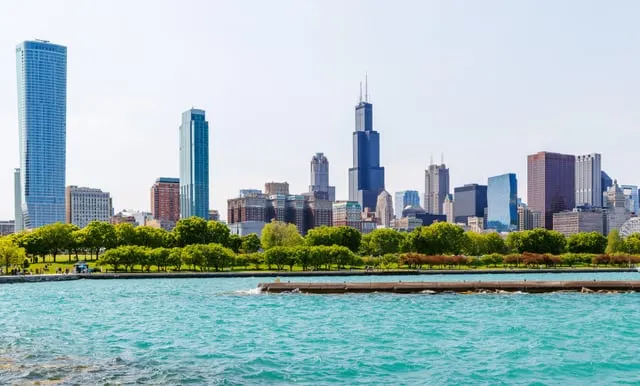
Chicago is a big lakefront city where landmark skyscrapers rise above the river, parks and beaches line Lake Michigan and museums sit close to the central streets. Ride the L around the Loop, walk the Riverwalk, then follow the lakefront to neighbourhoods that each have their own character.
Maps and trail data © OpenStreetMap contributors (ODbL).
We may earn a commission when you book through partner links, at no extra cost to you.
How Troovz stays freeThree days in Chicago make a rounded first visit, balancing the downtown icons with the skyscraper district north of the river. You see the Art Institute of Chicago and Skydeck Chicago, enjoy the view from 360 Chicago, and learn how the buildings came together at the Chicago Architecture Center. The pace stays easy, which suits couples, friends and families with older children.
Long weekend · 3 days · 2 adults ·
 1
 2
 3
 4
 5
 6
 7
12–16 min walk
10:12 Chicago Riverwalk · Morning · 45–90 min7–9 min walk
11:04 Chicago Cultural Center · Morning · 45–90 min6–8 min walk
11:55 Historic Route 66 Sign (Adams Street) · Morning · 5–15 min2–3 min walk
12:02 Art Institute of Chicago · Midday · 2–4 h6–8 min walk
14:08 Millennium Park · Afternoon · 1–2 hBus 3 + Bus 65 · about 22–33 min
15:41 Navy Pier · Afternoon · 2–4 hBlue Line · about 29–30 min
10:30 Skydeck Chicago (Willis Tower) · Morning · 45–90 min13–17 min walk
11:28 Chicago Picasso (Daley Plaza) · Morning · 10–20 min3–4 min walk
11:41 The Loop · Morning · 90–180 min9–12 min walk
13:20 Harold Washington Library Center · Midday · 30–60 minBus 10 · about 17–21 min
14:11 Field Museum · Afternoon · 2–4 h13–17 min walk
10:13 Chicago Architecture Center · Morning · 60–90 min5–7 min walk
11:18 Tribune Tower · Morning · 15–30 min10–13 min walk
11:43 Chicago Water Tower · Morning · 15–30 min4–5 min walk
12:02 360 Chicago (John Hancock Center) · Midday · 45–90 min5–7 min walk
12:52 Museum of Contemporary Art Chicago · Midday · 90–150 min19–25 min walk
14:41 Chicago Children's Museum · Afternoon · 2–3 hFlights, car rental and airport transfers for your trip: 3 days · 1 adult.
We may earn a commission when you book through partner links, at no extra cost to you.
How Troovz stays freeFly from anywhere, to anywhere.
Pick an area, then a place that fits your budget and style.
We may earn a commission when you book through partner links, at no extra cost to you.
How Troovz stays freeUses cookies
Tours and tickets matched to your plan and interests. Tap the heart to save one for Build your own.
We may earn a commission when you book through partner links, at no extra cost to you.
How Troovz stays freeViator
Viator
Viator
Viator
Viator
Viator
Viator
Viator
Tours, day trips and more on Viator
Browse all toursWhat to sort before your 3-day trip, plus a few useful words.
We may earn a commission when you book through partner links, at no extra cost to you.
How Troovz stays freePlug type A, B
120 V, 60 Hz
Mobile data for your trip. Set it up before you fly.
per plan, one phone
See plans(opens in a new tab)Leave your bags for a few hours or a day.
per bag a day
Find storage(opens in a new tab)Places to eat near your plan and your stay. Tap the heart to save one.
Chosen from places featured in respected travel and food guides, or on a halal certifier's list, as of November 2026. We don't take payment to include a place.
Please confirm with the restaurant if you have any allergies.
 11 min from Logan Square
Roast chicken · Wicker Park, Bucktown & Logan Square
Price level$$$
Gluten-free optionsVegan optionsVegetarian options
Sources
Gluten-free options: Source: the restaurant's own menu
Vegan options: Source: the restaurant's own menu
Vegetarian options: Source: the restaurant's own menu
Price level: Source: lulacafe.com, checked Nov 2026
 23 min from Chicago Water Tower
Deep-dish pizza with onions, mushrooms and green peppers · River North & Streeterville
Price level$$
Gluten-free optionsVegan optionsVegetarian options
Sources
Gluten-free options: Source: the restaurant's own menu
Vegan options: Source: the restaurant's own menu
Vegetarian options: Source: the restaurant's own menu
Price level: Source: ginoseast.com, checked Nov 2026
 33 min from River North
Enchiladas with country chicken and mole poblano · River North & Streeterville
Price level$$$
Vegan optionsVegetarian options
Sources
Vegan options: Source: the restaurant's own menu
Vegetarian options: Source: the restaurant's own menu
Price level: Source: fronteragrill.com, checked Nov 2026
 44 min from River North
Italian beef sandwich · River North & Streeterville
Price level$
Sources
Price level: Source: Uber Eats, checked Nov 2026
 54 min from The Loop
Wiener schnitzel · The Loop
Price level$$
Gluten-free optionsVegetarian options
Sources
Gluten-free options: Source: the restaurant's own menu
Vegetarian options: Source: the restaurant's own menu
Price level: Source: theberghoff.com, checked Nov 2026
 66 min from Magnificent Mile
Quesabirria · River North & Streeterville
Price level$$
Vegetarian options
Sources
Vegetarian options: Source: the restaurant's own menu
Price level: Source: tzuco.com, checked Nov 2026
No places near your plan with this option
 16
Eight chicken wings · Lincoln Park & Lakeview
Price level$
Halal-certified
Sources
Halal-certified: Listed as halal-certified by Halal Monitoring Services. Please confirm locally.
Price level: Source: Postmates, checked Nov 2026
 17
Butter chicken (chicken in a creamy tomato sauce) · River North & Streeterville
Price level$$
Halal-certified
Sources
Halal-certified: Listed as halal-certified by Halal Monitoring Services. Please confirm locally.
Price level: Source: Postmates, checked Nov 2026
 18
Burek with beef, onion and mozzarella · West Loop & Fulton Market
Price level$$
Sources
Price level: Source: rosemarychicago.com, checked Nov 2026
 19
Cheeseburger with fries · Lincoln Park & Lakeview
Price level$
Sources
Price level: Source: redhotranchchicago.com, checked Nov 2026
 20
Grilled strip steak · Wicker Park, Bucktown & Logan Square
Price level$$$
Sources
Price level: Source: pompettechicago.com, checked Nov 2026
 21
Chicken biryani (spiced rice with chicken) · Gold Coast & Old Town
Price level$$
Halal-certifiedVegetarian options
Sources
Halal-certified: Listed as halal-certified by Halal Monitoring Services. Please confirm locally.
Vegetarian options: Source: the restaurant's own menu
Price level: Source: Postmates, checked Nov 2026
Green escapes and the sea, a short trip from the centre. Planning information only.

Open public space

Open public space

Open public space

Free entry

Free entry

Free entry
One card for most rides on public transport. Airport routes are in Flights.
A reusable plastic card you register once, then load with value or an unlimited pass. It works on CTA trains and buses and on Pace buses, and the card fee comes back as transit value when you register it.
Per person, paid locally · as of November 2026
Your 3-day plan usesTram and metroBuses
Licensed taxis run on a meter, and a taxi from the airports usually costs several times the train fare. Ride apps such as Uber and Lyft also work, and a taxi app can book a licensed cab.
Typical costs, and how to pay.
Excluding your stay.
| Per person, per day | Budget | Mid-range | Comfort |
|---|---|---|---|
| Breakfast | USD 8 | USD 15 | USD 15 |
| Lunch | USD 12 | USD 13 | USD 31 |
| Dinner | USD 13 | USD 31 | USD 50 |
| Drinks | USD 8 | USD 13 | USD 20 |
| Getting around | USD 5 | USD 5 | USD 17 |
| Sights (entry tickets) | USD 61 | USD 61 | USD 61 |
| Total a day | USD 107 | USD 138 | USD 194 |
Sights are counted at the standard entry ticket. Guided tours cost more.
Typical prices, as of November 2026
Cards and contactless payments are widely accepted in Chicago shops and restaurants and on public transport. A few small cash-only places remain, so carry a little cash for those and for festivals.
ATMs run by banks are usually cheaper than stand-alone machines, though many banks also charge foreign cards a fee. If asked, choose to be charged in US Dollar. Your own bank may also charge a foreign-use fee. Check with your bank before you go.
Tipping is expected in Chicago. In a sit-down restaurant many visitors leave about one fifth of the bill before tax, and for a taxi or ride it is usual to add a tip too, with a few dollars a night for hotel housekeeping.
The Loop
Seasons, weather, and the events and holidays that change opening hours, crowds and prices.
Quick answers to common questions.
Plan on about three days for the main sights, and more if you like museums. Allow about 120 to 240 minutes for the Art Institute of Chicago, 120 to 240 minutes for the Field Museum, 45 to 90 minutes for Skydeck Chicago and 60 to 120 minutes for Millennium Park, plus time to wander the Loop, the Magnificent Mile and the lakefront. The day trips each usually need several hours to most of a day. As of 5 Nov 2026.
It depends on what you like. Summer is warm, with July the warmest month and cool breezes off the lake. September is a comfortable month for walking and October is mild and noticeably cooler. Winter is cold, cloudy and snowy, with January the coldest month, so indoor sights are the easy choice then. May is one of the wetter months, though warm days become common. Check the dates of any festival you want to see before you book. As of 5 Nov 2026.
Both airports have a train to the Loop. From O'Hare the Blue Line runs all day and night and usually takes about 40 to 45 minutes, and the fare is USD 5 when you board at the airport. From Midway the Orange Line usually takes about 20 to 25 minutes for USD 2.50, though it does not run through the whole night. Taxis and ride apps also work: the transit operator's own comparison puts a taxi at around USD 40 from O'Hare and around USD 25 from Midway, before the tip, and the time depends on traffic. As of 5 Nov 2026.
The 'L' trains and the buses cover most of the city. You can tap a contactless bank card or a phone on the reader for each ride: a bus ride costs USD 2.25 and an 'L' ride USD 2.50, with free transfers when you use the same card or phone. A one-day pass costs USD 5 for unlimited rides on 'L' trains and buses, and a reusable Ventra Card costs USD 5, returned as transit value when you register it. Ticket machines in 'L' stations take cash or cards. As of 5 Nov 2026.
Yes, tipping is expected rather than optional. In a sit-down restaurant a tip of about 15 to 20 percent of the bill before tax is usual, so check the bill first, as service is sometimes already added for large parties. Counter service is optional, taxi and ride-app riders usually add around 10 to 20 percent, and hotel housekeeping is usually left 2 to 5 dollars a night. As of 5 Nov 2026.
Cards, phones and contactless payments are widely accepted in shops, restaurants and on public transport. A few cash-only places remain, mainly small cheap-eats spots and some festivals and craft fairs, so a little cash is useful. For cash machines, one from your own bank or its network is a simple choice, and if a machine offers to charge you in your home currency, choose US dollars. As of 5 Nov 2026.
Prices on menus and shelves usually exclude sales tax, which is added at the register. Sales tax is 10.5 percent on most goods and meals, plus 0.5 percent city restaurant tax on meals and a further 1 percent inside the downtown restaurant-tax area. Hotel stays carry combined hotel taxes of about 17.4 percent of the room charge, larger downtown hotels add a 1.5 percent charge, and vacation rentals add 6 percent. Check whether your booking price already includes them. As of 5 Nov 2026.
Skydeck Chicago and the John Hancock Center observation deck both sell tickets for a chosen date and time, and booking the Hancock deck online costs less than the price at the gate. The Obama Presidential Center sells timed museum tickets ahead, and Frederick C. Robie House is visited on guided tours only, with advance tickets highly recommended. Garfield Park Conservatory is ticketed, and advance reservations are strongly recommended. Late arrivals may not be admitted at timed attractions. As of 5 Nov 2026.
The United States uses 120 V at 60 Hz, with plug types A and B, the flat-pin sockets. Many phone and laptop chargers accept this voltage, but visitors from countries with different sockets will need a plug adapter. Check the label on each charger: if it lists a voltage range that includes this one, only the plug shape needs changing. As of 5 Nov 2026.
Yes, English is the everyday language. In the latest community survey estimates, 64.6 percent of residents aged five and over speak only English at home, and Spanish is the most common other language, spoken at home by 23.7 percent. Signs, menus and transport information are in English. As of 5 Nov 2026.
Much of the city costs nothing to enjoy: Millennium Park, the Chicago Cultural Center, Lincoln Park Zoo and the lakefront are free to enter or open public space. The main costs are tickets, meals and where you stay. For an adult, Skydeck Chicago costs USD 32, the John Hancock Center observation deck USD 27, the Field Museum USD 30 and the Museum of Contemporary Art Chicago USD 22, and a one-day transit pass costs USD 5. A typical mid-range day for one person, with meals and transit but no sights, comes to about USD 70.92 before sales tax and tips. CityPASS Chicago bundles five attractions for USD 144 for adults. Prices change, so check each place. As of 5 Nov 2026.
Many central sights are within walking distance, and the 'L' trains and buses cover the rest. A bus ride costs USD 2.25 and an 'L' ride USD 2.50, a one-day pass costs USD 5 and a seven-day pass USD 20. Taxis run on a meter, and ride apps such as Uber and Lyft also work, as does the Curb app for booking a licensed taxi. As of 5 Nov 2026.
Walking is the main free pleasure. Millennium Park, the Chicago Cultural Center, the Harold Washington Library Center, Navy Pier, Maggie Daley Park, Lincoln Park Zoo, Lincoln Park Conservatory and the National Museum of Mexican Art are free to enter, and Grant Park, Buckingham Fountain, the Magnificent Mile and the lakefront are open public space. Oak Street Beach is free to enter as well. Check each page for opening hours before you go. As of 5 Nov 2026.
Oak Park, with the Frank Lloyd Wright Home and Studio, is usually about 16 to 23 minutes by train from Ogilvie Transportation Center. The Chicago Botanic Garden is about 48 to 50 minutes by Metra train and a short walk, Indiana Dunes about 64 to 71 minutes by South Shore Line train, and Starved Rock State Park about 90 to 120 minutes by car, as there is no train. Each trip usually takes several hours to most of a day. As of 5 Nov 2026.
Yes. Transit passes give unlimited rides on 'L' trains and buses for a set number of days: a one-day pass costs USD 5, a three-day pass USD 15 and a seven-day pass USD 20. They load onto a Ventra Card, which costs USD 5 and is returned as transit value when you register it. If you only ride a few times, tapping your own contactless bank card or phone needs no card at all. Check the pass page before you buy. As of 5 Nov 2026.
Skydeck Chicago sells tickets for a chosen date and entry time, and they are sold online. A standard adult ticket costs USD 32, and the operator asks guests to arrive a little early. Mornings usually have shorter lines, and on busy days it helps to choose your time before you travel. As of 5 Nov 2026.
Taxis run on a meter. The transit operator's own comparison estimates a taxi from O'Hare to downtown at around USD 40 and from Midway at around USD 25, before the tip, and the time depends on traffic. Taxi and ride-app riders usually add around 10 to 20 percent as a tip. Ride apps such as Uber and Lyft also work. As of 5 Nov 2026.
A free train, the Airport Transit System, links Terminal Five with Terminals One, Two and Three. From Terminal Five, ride it to Terminal Two and follow the signs to the CTA trains. O'Hare has no Terminal Four. From the other terminals the walk to the Blue Line station is usually under ten minutes from baggage claim. As of 5 Nov 2026.
For a first visit, usually yes. The three-day plan covers the Magnificent Mile, the Chicago Riverwalk, the Art Institute of Chicago, Millennium Park and Navy Pier on the first day, Skydeck Chicago, the Loop and the Field Museum on the second, and River North with the Chicago Architecture Center and the John Hancock Center observation deck on the third. Allow about 120 to 240 minutes for the Art Institute of Chicago, 120 to 240 minutes for the Field Museum and 45 to 90 minutes for Skydeck Chicago. The longer plans add more neighbourhoods and museums. As of 5 Nov 2026.
Spend the first day on the Magnificent Mile, the Chicago Riverwalk, the Chicago Cultural Center, the Art Institute of Chicago, Millennium Park and Navy Pier. Give the second to Logan Square, Skydeck Chicago, the Chicago Picasso, the Loop, the Harold Washington Library Center and the Field Museum. Use the third for River North, the Chicago Architecture Center, Tribune Tower, the Water Tower, the John Hancock Center observation deck, the Museum of Contemporary Art Chicago and the Chicago Children's Museum. The Cultural Center, Millennium Park, Navy Pier and the library are free to enter. The three-day plan on this page has the exact order and map. As of 5 Nov 2026.
It depends on where you stay and eat; entry tickets are the main fixed cost. For an adult, the Art Institute of Chicago costs USD 32, Skydeck Chicago USD 32, the Field Museum USD 30, the John Hancock Center observation deck USD 27, the Chicago Architecture Center USD 15, the Museum of Contemporary Art Chicago USD 22 and the Chicago Children's Museum USD 25, while Millennium Park is free to enter. The Plan at a glance box above the plan shows the entry total per adult. A three-day transit pass costs USD 15, and a typical mid-range day for one person, with meals and transit but no sights, comes to about USD 70.92 before sales tax and tips. As of 5 Nov 2026.
Average highAverage lowRainy days
Typical, based on past years. Not a forecast.
| Month | Average high | Average low | Rainy days |
|---|---|---|---|
| January | -1° | -5° | 12 days |
| January is the coldest month of the year and also the snowiest, with cloudy skies on many days and the occasional spell of deep cold. Indoor sights are the easy choice, and ZooLights and the Winter Flower Show at Garfield Park Conservatory both run into the first days of January 2027. | |||
| February | 0° | -5° | 9 days |
| February stays cold and snowy, though it is among the drier months overall, and the days slowly lengthen. The Chicago Auto Show fills McCormick Place from 13 to 21 February in 2027. | |||
| March | 3° | -1° | 11 days |
| March swings between winter and spring: snow is still possible, it is the windiest month, and milder days appear towards the end. On Saturday 13 March 2027 the river is dyed green and the St. Patrick's Day parade follows, and Pulaski Day closes city offices on Monday 1 March. | |||
| April | 8° | 4° | 12 days |
| April is the thaw, when rain showers take over from snow and the cool days warm gradually. | |||
| May | 15° | 11° | 12 days |
| May is one of the wetter months, but warm days become common and the lake breeze keeps the shoreline cooler than inland streets. Navy Pier's free summer fireworks began on 23 May in 2026, and Memorial Day on 31 May 2027 marks the start of the summer season. | |||
| June | 22° | 18° | 11 days |
| June is warm and one of the wetter months, with thunderstorms at their most frequent, and the lake breeze gives some relief on hot days. The Blues Festival fills Millennium Park in June and the Pride Parade is on Sunday 27 June 2027. | |||
| July | 26° | 22° | 11 days |
| July is the warmest month, with a little less wind than the rest of the year and cool lake breezes that provide some relief from summer heat. Taste of Chicago filled July in 2026, Lollapalooza ran from 30 July to 2 August, and Independence Day is observed on Monday 5 July 2027. | |||
| August | 25° | 22° | 11 days |
| August stays warm and is one of the wetter months, with thunderstorms still common. The Air and Water Show fills the lakefront on a mid-August weekend, and the Bud Billiken Parade on the South Side usually takes place in August as well. | |||
| September | 22° | 18° | 10 days |
| September cools down from the summer heat and rain eases a little, making it a comfortable month for walking. The Jazz Festival fills Millennium Park over Labor Day weekend, and Labor Day itself falls on 6 September in 2027. | |||
| October | 15° | 11° | 11 days |
| October is mild and noticeably cooler, with only a little snow late in the month. The Chicago Marathon is on 10 October 2027 and Open House Chicago, a free weekend of building access, is on 16 and 17 October 2027. | |||
| November | 8° | 4° | 11 days |
| November turns cold and grey, with cloudy days becoming frequent and the first light snow typically arriving. The holiday season opens with the Lights Festival on Michigan Avenue, the Christkindlmarket at Daley Plaza and the Thanksgiving parade on State Street. | |||
| December | 3° | -1° | 12 days |
| December is cold and cloudy, and snowfall picks up through the month. The Christkindlmarket runs until Christmas Eve, ZooLights and the Winter Flower Show are on, and Navy Pier holds Saturday fireworks on the lake in December 2026. | |||
Mar · Apr · May
Spring is a slow thaw: March can still bring snow and strong winds, April turns to rain showers and May is one of the wetter months, with milder days growing more frequent. The St. Patrick's Day parade and river dyeing in March and the first lakefront outings give the calendar a lift.
Jun · Jul · Aug
Summer is warm, with July the warmest month and thunderstorms most frequent in June, July and August, while breezes off the lake give some relief. It is the festival season, with the Blues Festival, Pride Parade, Taste of Chicago, Lollapalooza and the Air and Water Show, plus fireworks at Navy Pier.
Sep · Oct · Nov
Autumn starts mild and turns steadily cooler and greyer, with the first light snow typically arriving in November. The Jazz Festival over Labor Day weekend, the Marathon and Open House Chicago in October, then the Thanksgiving parade and holiday lights in November fill the calendar.
Dec · Jan · Feb
Winter is cold, cloudy and snowy, with January the coldest month and the lake adding to snowfall. Holiday markets, ZooLights, the Winter Flower Show and the Auto Show give plenty of reasons to be out, and indoor museums and theatres are easy to reach.
Coming up in the next 12 months. to see what falls during your trip.
Admission to the market is free. Hours are shorter on Thanksgiving and Christmas Eve, so check before you go.
Entry is by ticket and the zoo encourages buying ahead because of high guest volumes. Public transport or a ride service is suggested over parking.
The displays are free and visible over the lake and skyline. Winter evenings are cold, so dress warmly.